
How Advanced Facial Massage Skills Develop: From Learning the Method to Skilled Practice
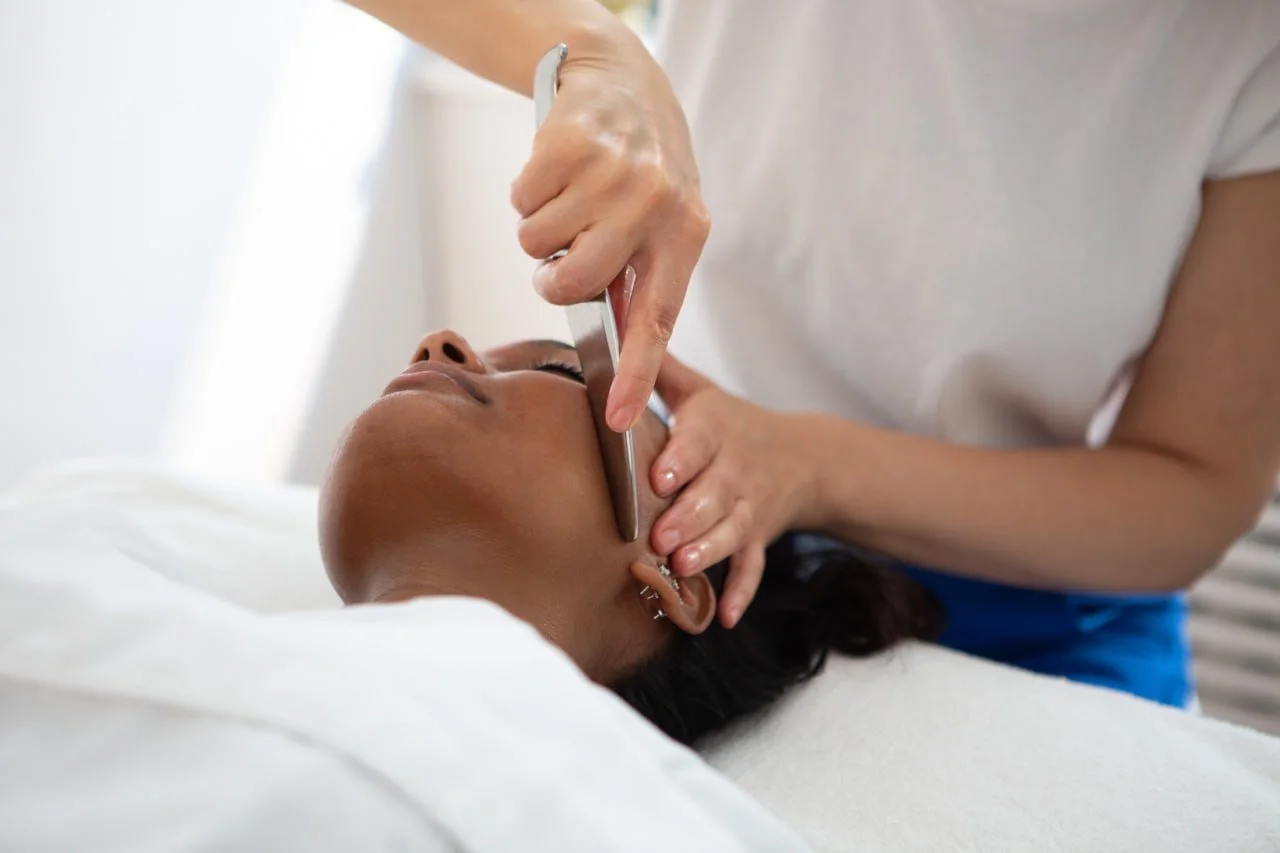
Learning an advanced facial massage method and becoming skilled in it are not the same thing.
A training can give you structure, technique, correction and direction. It can show you how the work is organized, where your hands should be, how pressure and depth are applied, and how individual techniques connect.
But manual skill usually develops when that knowledge starts becoming familiar in your own hands.
That takes practice.
An instructor can demonstrate the work, guide your hands, correct details and help you understand what needs to improve.
An instructor can guide and correct you, but the skill still has to be built through your own practice.
For estheticians, massage therapists and bodywork practitioners entering advanced facial massage or facial sculpting work, understanding this difference is important.
The course is the beginning of the learning process — not the end of it.
If you are still comparing programs, read How to Choose Advanced Facial Massage & Sculpting Training: What to Look For Before You Invest.
What level of experience do you need before advanced facial massage training?
Ideally, the practitioner already has some hands-on experience and understands what it means to work consistently with clients.
In my experience, advanced training tends to build on skills that are already beginning to develop — touch, coordination, body positioning, observation and the ability to apply correction in practice.
This does not mean that every student needs the same professional background.
An esthetician may already be comfortable working with the face and skin but have less experience with deeper manual work.
A massage therapist may already have a stronger sense of pressure, tissue quality and body mechanics but be newer to detailed facial work.
What matters is not that everyone enters the room with identical experience.
What matters is that the student has enough foundation to engage with advanced material — and understands the commitment required to develop it afterward.
Can someone newer to hands-on work take advanced training?
Yes, in some cases.
If you are newer to manual work but are prepared to practice extensively during and after the training, work regularly on different people, receive correction and invest real time in developing coordination and touch, an advanced program may still be appropriate.
But the student needs to understand that the course itself cannot replace the practice required to develop the hands.
If you are newer to manual work but are prepared to practice extensively during and after the training, work regularly on different people, receive correction and invest real time in developing coordination and touch, an advanced program may still be appropriate.
For someone starting completely from zero, however, an intensive advanced training may not always be enough on its own.
The student may be trying to learn foundational touch, body positioning and manual coordination at the same time as more complex technique.
In that situation, the question is not simply whether you can attend the training.
The better question is whether you will be able to absorb and apply what is being taught.
When can individual preparation make a difference?
Some students benefit from individual preparation before entering an advanced group training.
Private instruction can help establish the basic hands-on skills that make it easier to get more from the intensive training: contact, pressure, positioning, coordination and basic comfort working around the face and treatment table.
This does not replace the advanced training.
It prepares the student to receive more from it.
A student who is less experienced may need a different starting point from a practitioner who has already spent years working with clients.
That is why the format of the education matters.
Small-group, semi-private and individual instruction do not serve every student in exactly the same way.
The right starting point depends not only on what you want to learn, but also on what you are bringing into the room.
Why does practice on different people matter?
Although the underlying anatomical structure is largely the same, no two faces are exactly alike.
Small differences in proportions, tissue quality, muscular tension, asymmetry, sensitivity and response to touch can significantly change what the practitioner feels under the hands.
At first, it is natural to focus on remembering the protocol.
With practice, attention begins to shift.
You start noticing how the same technique is received differently from one person to another.
The method may remain consistent, but pressure, depth and the amount of time spent in an area may change according to tissue quality, sensitivity and level of tension.
This is one reason working on different people is so important.
The practitioner is no longer simply repeating what was demonstrated during training.
They are beginning to understand how the same method has to be applied to different people.
When does a protocol become skilled practice?
A protocol gives structure.
It tells you where to begin, how the treatment progresses and how the individual parts relate to one another.
But structure alone is not the skill.
The practitioner still has to observe what is happening under the hands.
They need to recognize tension, mobility, sensitivity and tissue response — and understand how to work within the method without making the treatment mechanical.
This is what the FaceBioLift™ principle means in practice:
The method is consistent. The hands adapt.
The sequence gives the practitioner a framework.
Practice develops the ability to work within that framework with greater awareness and precision.
The FaceBioLift™ training manual describes this progression in the same way: students first learn the sequence, then develop the ability to observe tissue response and adapt within that structure.
What happens after the intensive training ends?
Even a thorough intensive cannot fully recreate what happens once a practitioner begins using the method independently.
This is when the work starts to settle into the hands.
It is also when the practitioner begins to identify their own patterns.
Some parts become natural quickly.
Others require repetition.
Some questions only appear after working on several different people.
A movement you understood during training may feel less clear once you are alone.
Pressure may gradually become stronger or lighter than intended.
A transition may lose continuity.
Your body position may change without you noticing.
A section of the protocol may still feel like something you are remembering rather than something you fully understand.
These are not signs that the learning process has gone wrong.
They are often the point at which practice starts showing you what still needs refinement.
Why does receiving correction matter after you begin practicing independently?
Corrections received during training are essential.
But they are different from corrections received after you have practiced independently.
During the intensive, you are still taking in new information.
You are learning the structure, hand placement, pressure, transitions, body positioning and rhythm at the same time.
Afterward, you begin using the work without the instructor standing beside you.
That changes the nature of the questions.
You are no longer asking only:
Am I doing this correctly?
You begin asking:
Why does this part still feel less natural?
Why does my pressure change here?
Why does this transition lose continuity?
Why does the work feel different on this person?
Correction becomes more specific because it is now connected to your own experience.
This is also why class size and direct instructor correction matter when choosing advanced facial training: the more clearly the foundation is established, the more useful later refinement becomes.
Why post-training supervision matters
I see post-training supervision not simply as additional support, but as an important final stage of advanced education.
By the time a practitioner returns for supervision, they are no longer approaching the work as a student seeing the method for the first time.
They return with experience.
They have practiced independently, worked on different faces, encountered different tissue responses and begun to understand where their own strengths and uncertainties are.
This creates a different level of learning.
At SENSO Academy, students return after a period of independent practice for a private FaceBioLift™ supervision session. They perform the complete protocol while their work is observed and refined.
The supervision session is an opportunity to polish the technique and the protocol as a whole, revisit questions that appeared during independent practice, refine pressure and depth, correct details that may have changed once the student began working alone, improve transitions and continuity, and look at the treatment with a more experienced eye.
The purpose is not to teach the method again.
It is to refine what has already been learned and practiced.
The practitioner now has something they did not have during the original training: their own experience with the method.
That experience makes refinement more precise.
A correction is no longer abstract.
The student understands exactly where the difficulty appears because they have encountered it repeatedly in practice.
For this reason, supervision can help bring the work closer to the level of precision, confidence and continuity that advanced practice requires.
The current FaceBioLift™ training structure includes this post-training refinement after independent practice, with supervision focused on technique accuracy, hand placement, pressure, depth, transitions, continuity and practitioner body mechanics.
What does it mean to develop as a practitioner?
For me, advanced education is not about collecting more techniques.
It is about developing the quality of the practitioner behind the technique.
Better hands.
Better observation.
More efficient body mechanics.
A clearer understanding of tissue response.
More confidence in knowing what you are feeling.
And the ability to bring the different parts of a treatment together so that the work feels coherent rather than mechanical.
Completing a course is a milestone. It is not yet a measure of skill.
It does not tell you how the work will feel in your hands three weeks later.
It does not tell you how you will respond to a face that feels different from the one you practiced on during training.
It does not tell you whether your body mechanics will remain efficient when you are working independently.
And it does not tell you whether the treatment will feel connected once you no longer have the instructor beside you.
Those things develop through practice.
At SENSO Academy, I think of the learning process in three stages:
During the intensive, the practitioner learns the method through demonstration, hands-on practice and direct correction.
Independent practice is where the work begins to settle into the hands and real questions start to appear.
Post-training supervision is where that experience is reviewed, corrected and refined.
For me, that is how a learned method gradually starts becoming skilled practice.
Questions to ask yourself as your skill develops
Before you begin advanced training — and once you start practicing on your own — it is worth asking yourself:
What level of hands-on experience am I bringing into the training?
Am I prepared to practice consistently afterward?
If I am newer to manual work, would individual preparation help me build a stronger foundation?
How will I find enough different people to practice on?
What am I beginning to notice under my hands?
Which parts of the method still feel mechanical?
Where does my pressure or body positioning tend to change?
What questions appeared only after I began practicing independently?
Where do I still need correction or refinement?
Am I becoming more confident in the protocol — or more perceptive in the work itself?
Learning the method is one stage.
Developing the skill is what happens when knowledge, practice, correction and experience begin to work together.
Learn more about the FaceBioLift™ Masterclass at SENSO Academy.