
Teeth Grinding and Jaw Clenching: How FaceBioLift Relieves Bruxism Tension
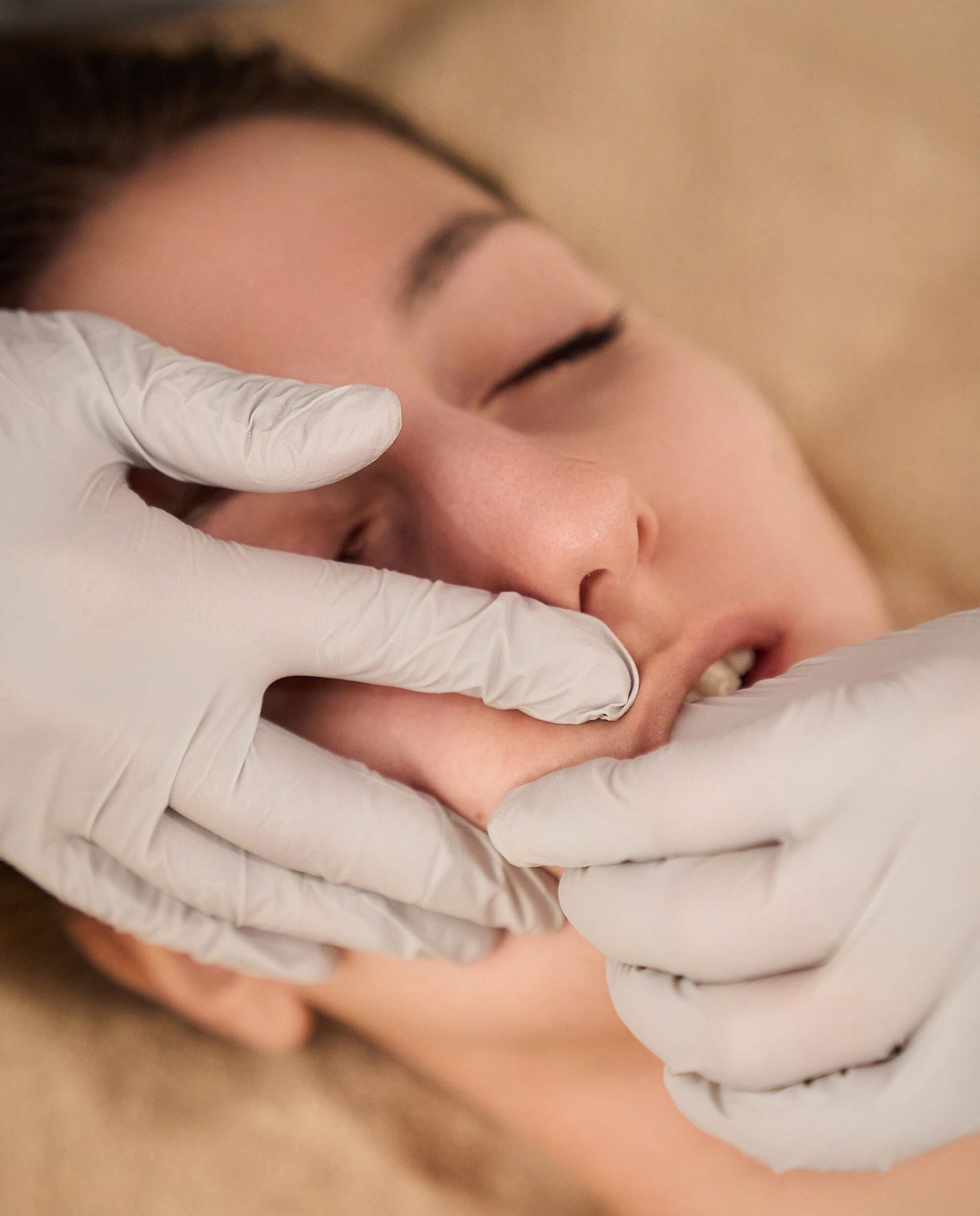
Most people have no idea how hard they clench until the jaw finally lets go, and then the contrast is impossible to miss: the teeth are no longer pressed together, the temples go quiet, the mouth opens without effort, and the lower face stops feeling quite so solid.
Bruxism runs both while you are awake and while you sleep, which is part of what makes it stubborn. A few people grind loudly enough for a partner to hear it across the bed, but far more just hold the jaw tight for hours at a stretch, and although that version is silent, it wears the muscles down all the same.
FaceBioLift™ uses external and intraoral (buccal) massage to work through that tension. It cannot stop nighttime grinding or protect the teeth from wear, so a night guard and proper dental care keep their place. What the massage can address is the tight, overworked muscle pattern that grinding leaves behind.
Why Bruxism Happens: Stress, Sleep and Structure
Stress gets blamed for everything, yet here the blame is fair. A difficult meeting begins, your shoulders climb, your teeth come together, and twenty minutes later you are still braced that way without having decided to be, the jaw having quietly enlisted itself into the problem.
Sleep bruxism is harder to pin down because it happens beyond conscious control, and it tends to be fed by several overlapping factors rather than a single cause:
● poor or broken sleep;
● stress carried into the night;
● certain medications;
● alcohol and caffeine.
Because those inputs vary so much from person to person, two people can grind for reasons that have almost nothing in common.
Structure plays its part too. The temporomandibular joint sits just in front of the ear where the lower jaw meets the skull, surrounded by the muscles that open, close and steer the jaw: the masseter toward the back of the cheek, the temporalis along the side of the head, and the deeper pterygoid muscles further in. Since these are so close together, trouble in one rarely stays put, surfacing instead as cheek tenderness, temple pressure, pain around the ear, neck tension, or a headache that seems to come from nowhere.
Bruxism also keeps company with temporomandibular disorders, though the two are not the same thing. Evidence reviews group bruxism alongside joint pain, headaches, clicking, neck pain and limited jaw movement, and they describe the whole category as a tangle of mechanical, psychological and biological factors. Tangle is the right word, because there is seldom a single switch to turn off.
What Clenching Does to the Face
The masseters are powerful by necessity, since chewing asks a lot of them, but hold them partly contracted through an entire day and they start to feel thick and tired, often more sore on the side that does the heavier work, stiff first thing in the morning and stiffer again by late afternoon.
The consequences show up differently depending on the person: for some it registers as ache and tenderness, while for others the first clue is the face itself, where the lower cheeks look heavier, the corners of the jaw grow more pronounced, and one side photographs unlike the other when the chewing and clenching habits are lopsided.
None of that means a single appointment shrinks the muscle. The change is more immediate and more modest than that, because once a tightly held area begins to soften the face simply stops looking so compressed. For anyone searching for clenching jaw relief NYC, that sensation often lands harder than any mirror change, arriving as a small surprise along the lines of: so this is what my jaw feels like when I am not holding it up around my ears.
How Intraoral (Buccal) Massage Reaches Muscles a Night Guard Cannot
A night guard and intraoral (buccal) massage do genuinely different jobs, which is easier to see laid side by side than argued in prose:
| Night guard | Intraoral (buccal) massage | |
|---|---|---|
| Main job | Barrier between upper and lower teeth | Manually releases tense jaw muscle |
| Reaches the masseter | Loads the bite, does not work the muscle | Works it from inside and outside at once |
| Effect on wear | May reduce dental wear overnight | No effect on wear |
| When it acts | During sleep | During and after the session |
| Best role | Protecting the teeth | Easing the muscular tension behind clenching |
During FaceBioLift the practitioner first works externally along the jaw, cheeks and temples, then moves to gloved hands inside the mouth to reach the inner cheek and the deeper structures around the jaw. Because the masseter can be held from inside while it is worked from outside, the release reaches tissue that surface massage never quite gets to, and that second angle also gives a far clearer read of where the muscle is actually resisting.
This is where the personalized side of the method matters. One core protocol underpins every session, but it is shaped in real time rather than run identically on everyone, with more time spent where a muscle is still holding, less where it has already softened, and pressure matched to whatever the tissue can take that day. Clients describe this precisely when they talk about work that manages to be relaxing and strong at once, plainly guided by someone who understands the anatomy. None of it should feel brutal. The session also refuses to stop at the jaw, moving across the décolleté, neck, face and scalp, since a braced neck and a clenched scalp keep feeding tension back in however well the masseter itself is released.
The research points the same way. A 2023 systematic review of 20 randomized trials, spanning massage, pressure release, joint mobilization, soft-tissue work and intraoral manual pressure, found that manual therapy improved pain, mouth opening and jaw-related disability, with the clearest gains showing up over short and longer-term follow-up rather than immediately. That stops short of proving FaceBioLift treats bruxism itself, which is why a bruxism massage treatment NYC clinics offer should be framed honestly, as support for the muscular fallout rather than a cure for the habit.
What Relief Actually Feels Like After Treatment
The jaw rarely turns weightless in an instant; the changes tend to be quieter than that, felt as a mouth that opens more smoothly, a cheek less tender under pressure, teeth that rest slightly apart instead of meeting all day, temples that stop aching, and a lower face that carries less density. Many people leave lighter and refreshed, and mention looking a little younger and less tight without having gone anywhere near botox.
There is a useful side effect, too, which is that the relaxed state finally hands you a point of comparison, so you start catching yourself clench while driving, while typing, while reading a message you would rather ignore, an awareness that is equal parts revealing and mildly irritating. Some tenderness after deeper intraoral work is normal, especially at a first appointment, though strong pain, bruising or soreness that lingers is not the aim and should be raised with the practitioner.
How Long Does the Relief Last?
One session might keep the jaw softer for several days, sometimes longer, and what happens next decides which. Slide back into broken sleep, all-day clenching and constant gum chewing and the muscles tighten again fairly quickly, whereas milder tension can still feel eased a fortnight on.
Regular sessions matter because they stop the jaw from snapping back to its tightest state so fast, which is exactly why experienced clients tend to recommend a course of roughly seven to ten treatments over judging the work by a single visit. No teeth grinding jaw massage Manhattan offers can erase a habit that recurs every night; the honest aim is to reduce the muscular aftermath and keep the jaw easier to live with between appointments.
Massage Is Only One Part of the Answer
A night guard protects the teeth and massage eases the muscle, but other pieces of the problem respond to conservative care, and often several need to move at once:
● education about the habit and what triggers it;
● sleep hygiene;
● avoiding triggers such as daytime clenching and gum chewing;
● heat or ice on sore muscles;
● jaw exercises or physical therapy.
Persistent symptoms deserve a proper assessment, since jaw locking, swelling, numbness, tooth damage, severe pain or difficulty opening the mouth are not hints that you need a stronger facial. FaceBioLift is at its most useful in an honest role, giving tired jaw muscles the chance to soften and reaching what a night guard cannot, and for a face that has been holding weeks of stress, that alone can feel like a great deal.