
Facial Asymmetry: Why One Side of Your Face Ages Faster Than the Other
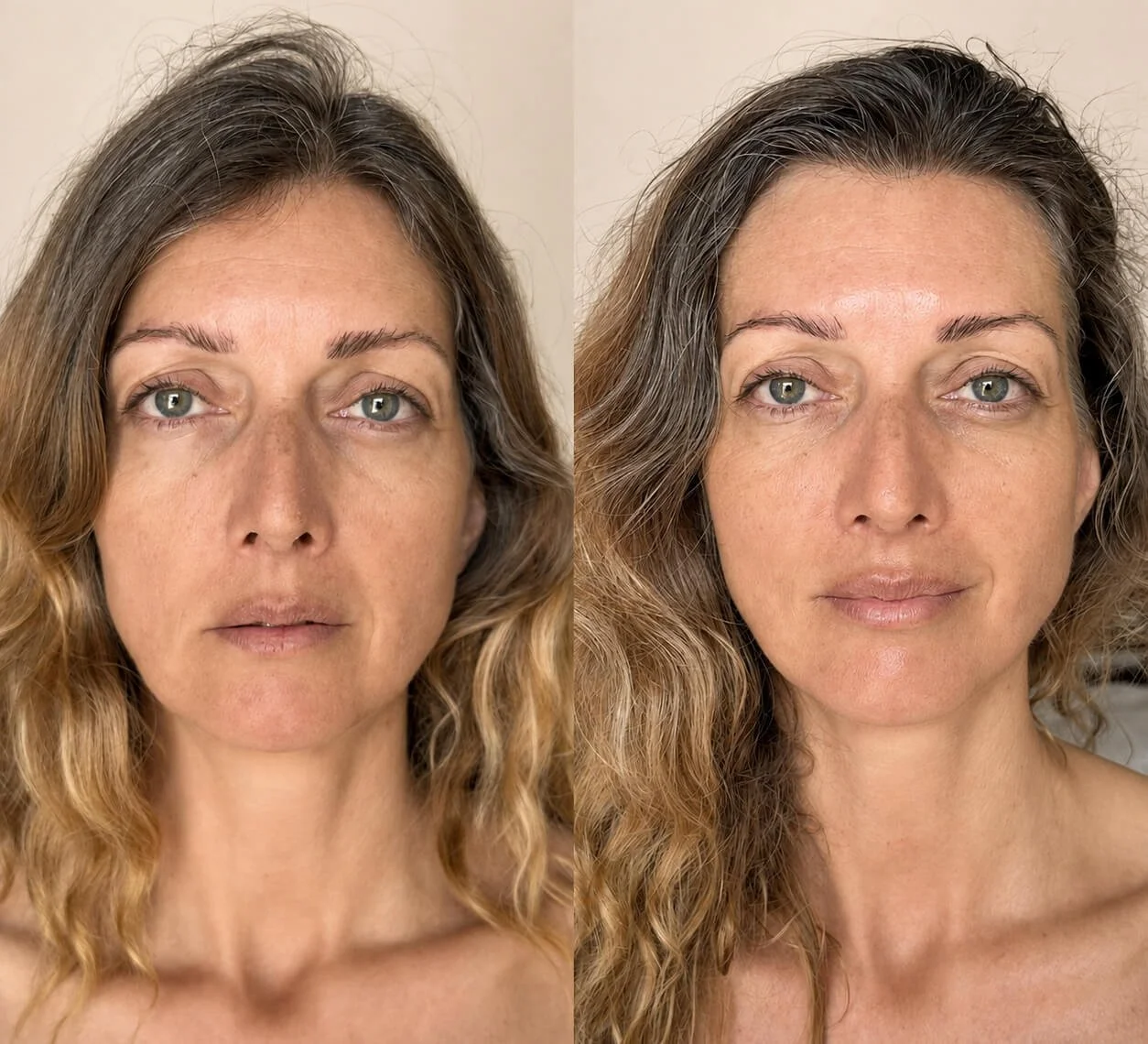
Most faces are uneven, and there is nothing wrong with that. One brow sits higher. One cheek has a little more volume. The jaw drifts slightly when you smile.
You may go years without noticing, until somebody flips a selfie and your own face looks like a stranger's.
What age changes is not the unevenness but how easily it shows. A full cheek starts reading as heavy, a fold deepens sooner on one side, the jawline softens unevenly, and the question begins to nag: why is my face asymmetrical now when it never looked this way before?
The answer is seldom one dramatic cause. Bone, fat, fascia, muscle tension, sun exposure and years of ordinary habits all surface together, which is the layered picture SENSO is built to read rather than paper over.
Sleep Position, Chewing Habits and Dominant-Side Tension
People love blaming the pillow, and there is some logic to it. Sleeping on the same side means one cheek spends hours pressed to fabric while fluid settles unevenly, so you wake with one eye puffier or one fold deeper.
That morning difference is real. Whether side-sleeping alone permanently ages half the face is far less certain. More likely, repeated compression makes an existing imbalance easier to see once the skin has thinned.
Chewing ties more directly to muscle. Many people favour one side without realising it, from a sensitive tooth, a bite that feels natural, or plain habit, and over time those muscles do more work.
Add clenching, and the masseters at the back of the jaw tighten every time you brace your teeth. The side under the heavier load feels denser and can look fuller through the lower face. That is not always aging; sometimes one side simply looks older because it is more tense and compressed.
This is where SENSO's founding belief does real work. Across more than eight years of applied research behind FaceBioLift™, the guiding idea has held that the face reflects the nervous system and its stored tension, so an uneven jaw is treated as a pattern of guarding to release, not a flaw to force into line.
Your Face Is Built in Layers
Skin is only the top of the story. Beneath it are the fat compartments, connective tissue, retaining ligaments, muscle and bone, all changing over time and none obliged to change at the same rate on both sides.
Research moved past the idea that everything falls with gravity. What actually happens is more layered:
● the facial skeleton remodels;
● fat compartments lose volume or migrate;
● retaining ligaments weaken;
● the skin itself changes through intrinsic aging plus sun and smoking.
The cheek in particular is not one smooth pad but separate superficial and deep compartments, each with its own borders. A small shift in one can change the fold beside the nose, the hollow under the eye, or the weight of the lower cheek.
Two sides can therefore age differently without anything being wrong. One may start with slightly different bone projection, fat may be placed differently, and years of sun through a car window may weather one side more. Faces are not built from mirrored halves; they only look that way from across a room.
How Fascia and Muscle Imbalance Show Up Visually
Fascia is the connective tissue linking facial structures, and one key layer is the superficial musculoaponeurotic system, or SMAS. You never see fascia directly, only what happens above it.
When soft tissue on one side moves freely while the other feels tight, the face tends to show it as:
● one cheek sitting slightly lower;
● a deeper fold beside one corner of the mouth;
● a jawline that looks heavier on one side;
● one corner of the mouth moving less freely;
● uneven puffiness beneath the cheekbone.
Muscle tension exaggerates all of it. A tight masseter widens the lower face, tension around the mouth pulls one side differently in expression, and a braced temporalis adds temple pressure.
Because the two sides seldom respond in the same direction or by the same amount, an uneven face massage Manhattan clients seek should never treat both halves as if they need identical work.
How Targeted Massage Works Without Overcorrecting
A considered session never opens with the crude logic of "this side looks lower, so push it up harder." The practitioner first feels how the tissue moves, since the two sides usually present different problems:
| Often looks | Actually needs | |
|---|---|---|
| Tighter side | slimmer, more restricted | slower pressure, more time on the masseter |
| Puffier side | fuller, softer | gentler work aimed at moving fluid |
| "Lower" side | like it needs lifting | frequently the least force of all |
FaceBioLift makes this possible by pairing external massage with intraoral, or buccal, work performed inside the mouth with gloved hands. A session runs in a consistent order:
Cleansing and a warm towel to open.
Deep myofascial release and rhythmic lymphatic drainage across face, jaw and neck.
Biomechanical vibration and stainless steel IASTM tools to refine tone and contour.
The intraoral component, reaching the inner cheek and deeper jaw muscles from a second angle.
iS Clinical skincare, red light therapy, and a closing towel.
Throughout, the décolleté, neck, face and scalp are all treated, because a braced neck or scalp keeps pulling the face out of sync.
The protocol is single and consistent, yet adapted live to the person on the table. Restraint is the point, since chasing mathematical symmetry in one sitting only leaves the face irritated and overworked.
The wider evidence agrees. A review of 20 randomized trials found hands-on techniques helped pain, jaw movement and disability, with the clearer gains arriving over repeated treatment rather than a single session.
What Kind of Change Is Realistic?
After one session, one side often feels softer, the jaw moves more evenly, morning puffiness settles, and the lower face photographs a little more balanced.
Then ordinary life resumes. You sleep, chew, clench through work, and catch an afternoon of sun on one side of the car, so the first result will not hold exactly as you left it.
With consistent work, the useful change is steadier movement and less recurring tension. One side stops tightening so fast. Puffiness evens out. The face looks more balanced because it is no longer fighting the same pattern every day.
That is the honest goal of facial asymmetry treatment NYC practitioners can deliver: not a perfectly mirrored face, but your own face with less tension pulling one side out of sync.