
Why Does My Face Look Tired Even When I Get Enough Rest?

You slept eight hours. You drank water. You didn’t even doom-scroll until 1 a.m. last night.
So why does your face still look like it filed a formal complaint?
That tired look isn’t always about sleep. Sometimes your body is rested, but your face is still holding fluid, tension, or stiffness in the deeper tissue. The skin may look dull. The eyes may look puffy. The jaw may feel tight. The cheeks may seem heavier than usual.
Annoying? Yes. Mysterious? Not really.
Your face is not just skin sitting on bone. It’s a layered structure made of muscles, fascia, blood vessels, lymphatic vessels, nerves, and fluid-filled spaces between cells. When those layers move well, your face tends to look clearer and more awake. When they get sluggish, compressed, or tense, the “tired face” shows up - even after good sleep.
First Question: Am I Actually Tired, or Does My Face Just Look Tired?
That’s the better question.
Because there’s a real difference between feeling exhausted and looking exhausted. You can feel fine and still see puffiness under your eyes. You can wake up mentally sharp and still notice a softer jawline, heavier cheeks, or a duller expression.
That usually points to one of a few things:
fluid sitting in the tissue longer than it should
tension in the jaw, forehead, temples, or neck
poor tissue glide under the skin
inflammation from stress, food, allergies, or hormones
slower lymphatic movement after sleep, travel, or inactivity
The face is honest in a slightly rude way. It shows tiny internal changes before you feel them.
One of the main systems involved here is interstitial fluid. This is the fluid that sits between your cells. It helps carry nutrients, waste products, proteins, and signaling molecules through the tissue. Research describes the interstitium as the space made of fluid, proteins, solutes, and extracellular matrix around cells, while interstitial fluid is formed by capillary filtration and cleared by lymphatic vessels.
In simple terms: your face has an internal fluid system. When it moves well, your face looks fresher. When it lingers, your face can look puffy, dull, and heavy.
Puffiness Is Usually a Drainage Issue
Let’s be blunt. A lot of “tired face” is just fluid.
Not always, but often.
You see it under the eyes first because that area is delicate. Then maybe the cheeks look slightly swollen. The lower face can feel less defined. Your face may look bigger in the morning, then improve later in the day as you move, talk, drink water, and stand upright.
That’s not your imagination.
Edema, or tissue swelling, happens when fluid formation and fluid removal fall out of balance. One review explains that swelling appears when interstitial fluid builds faster than lymphatic clearance can remove it. Under normal conditions, lymph formation has a strong safety margin, but swelling occurs when that balance gets overwhelmed.
Now, most everyday facial puffiness is not a medical crisis. It’s usually mild fluid retention. Still, the mechanism is similar enough to matter: fluid enters the tissue, and the lymphatic system needs to clear it.
So what slows things down?
salty food
alcohol
allergies
hormonal changes
stress
poor sleep posture
jaw clenching
long screen time
not moving much during the day
A facial massage does not “detox” your face. That word needs to retire. What skilled manual work can do is support fluid movement, soften pressure in the tissue, and help the face look less congested.
Much better. Much more honest.

Second Question: Why Does My Face Look Tense Even When I’m Relaxed?
Because your face may not be relaxed.
You can feel calm and still hold tension in your jaw. You can enjoy your day and still keep your brows slightly contracted. You can sleep well and still wake up with a tight masseter because you clenched your teeth all night.
The face has memory. Not in a mystical way - in a mechanical way.
Your muscles repeat patterns. Your fascia adapts to pressure. Your nervous system gets used to holding certain areas “on.” If your jaw works overtime, the lower face may look heavier. If your forehead is always engaged, the upper face can look strained. If your neck is tight, drainage can feel slower around the jaw and under the chin.
This is where fascia becomes important.
Fascia is connective tissue that surrounds and links muscles and other structures. It helps transmit force through the body, and researchers have described the fascial network as part of a bodywide tensional system that may also play a role in sensory perception.
In the face, fascia affects how smoothly layers slide over one another. When glide is good, the face feels more open. When glide is restricted, the face can look stiff, tired, or oddly flat.
You may know hyaluronic acid as a skincare ingredient, but it also exists naturally inside connective tissue. It helps tissue layers slide. A study on fascia thickness and flexibility notes that loose connective tissue contains high concentrations of hyaluronic acid, which acts as a lubricant. The same paper explains that without mechanical loading, this substance can become more viscous and restrict fascial glide.
That’s the part skincare ads usually skip.
Sometimes the face doesn’t need another product. It needs movement in the tissue underneath.
Why Skincare Alone Doesn’t Always Fix a Tired Face
Skincare can help texture, brightness, hydration, and barrier health. Good skincare matters.
But let’s not pretend an eye cream can manually drain fluid or release a clenched jaw.
A tired-looking face often sits deeper than the skin surface. It can involve:
lymphatic flow
muscle tension
fascia glide
circulation
inflammation
neck and jaw mechanics
This is why someone can use expensive skincare and still say, “Why do I look exhausted?”
Because they’re polishing the surface while the deeper tissue is still stuck, puffy, or tight.
That does not mean skincare is useless. It means skincare is only one part of the picture. If the face looks tired because the tissue is congested, tense, or poorly mobile, a topical product has limits.
Aging Makes the Face Less Forgiving
When you’re younger, your face often rebounds faster. Eat salty food, sleep badly, cry, fly, stress out - the face may recover by lunchtime.
Later, the same little insults linger.
This has a lot to do with changes in tissue behavior. We usually talk about aging as collagen loss, wrinkles, and volume changes. Fair enough. But connective tissue also changes. Fascia can thicken in some areas. Tissue glide can become less smooth. Fluid can sit longer.
One study found clear differences in fascia thickness between younger and older adults, with some links between tissue thickness and flexibility. The authors also suggested that both tissue stiffness and fluid characteristics may help explain changes in mobility.
The face follows the same basic logic. Tissue that moves well tends to look livelier. Tissue that stays compressed or stagnant tends to look tired.
That’s why maintenance matters. Not in a dramatic “fight aging” way. More like brushing your teeth. You don’t wait until everything feels stuck before you start caring for it.

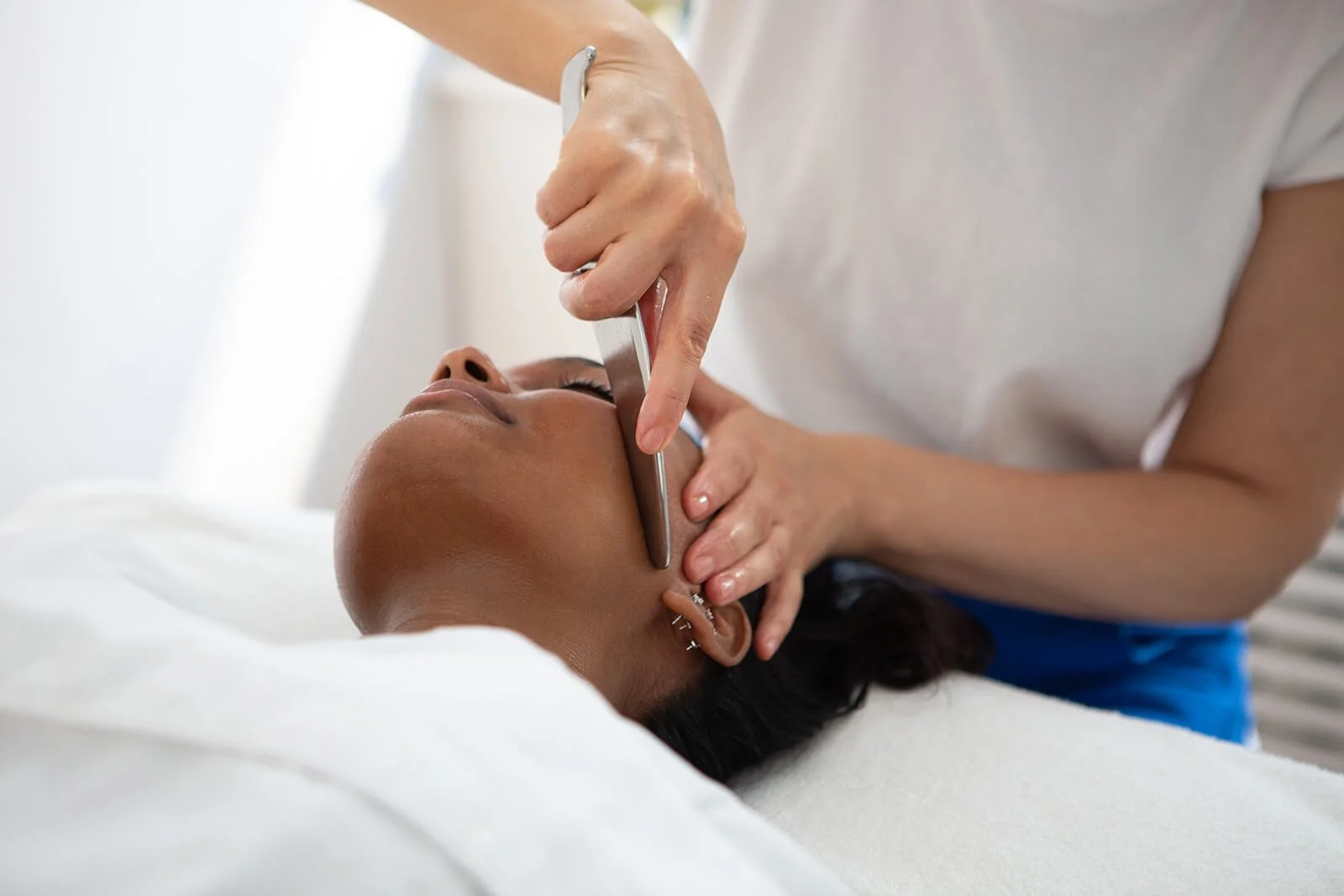
What Facial Massage Can Actually Do
A good facial massage should never feel like random rubbing with nice oil.
It should have a point.
Different techniques can do different jobs:
Lymphatic work can encourage excess fluid to move.
Sculptural massage can soften tight muscles and improve facial contour.
Buccal massage can reach tension inside the cheeks and jaw.
Fascia-focused work can improve glide between tissue layers.
Neck work can support drainage around the lower face.
This is why the result can look surprisingly fresh when the technique is done well. The face has not been “changed.” It has been relieved.
Fluid moved. Tension softened. The tissue got more space.
That’s also why some people look brighter after one session, while others need consistent work. A face that has been clenching, retaining fluid, or sitting in stress patterns for years will not always reset in 60 minutes. Still, even one good treatment can show you what your face looks like when it stops bracing.
So, Why Does Your Face Look Tired?
Usually, it’s not one thing.
It’s the small pile-up:
a little fluid retention
a tight jaw
stiff fascia
shallow breathing
neck tension
stress hormones
less movement than your body wants
None of these has to be extreme. Together, they change the face.
That’s why the answer is not always “sleep more.” Sometimes the better answer is: help the face move, drain, and soften.
A rested face is not only about rest. It’s about flow. It’s about tissue that can glide. It’s about muscles that know how to release after a long week of holding everything together.
And that’s where skilled facial massage earns its place. Not as a luxury add-on. Not as vague wellness fluff. As hands-on work for the systems that shape how your face looks when you wake up, walk into a meeting, or catch your reflection in bad elevator lighting.
Your face may not need fixing.
It may just need to stop carrying the whole week.